Testimonials from SUBE-alumni
Discover Alumni Paths
Where can a degree in Sustainable Urban Bioscience Engineering take you? Discover how our alumni are shaping sustainable solutions across industries.
Read their stories to learn how the SUBE programme prepared them for their careers, what challenges they tackle today, and how their sustainability mindset influences their work every day.
Stay tuned—this page is updated regularly with with new alumni stories and career journeys!
- Graduated from the Master SUBE in 2025
- Function: PhD-researcher in the research group A-PECS of the Department of Bioscience Engineering
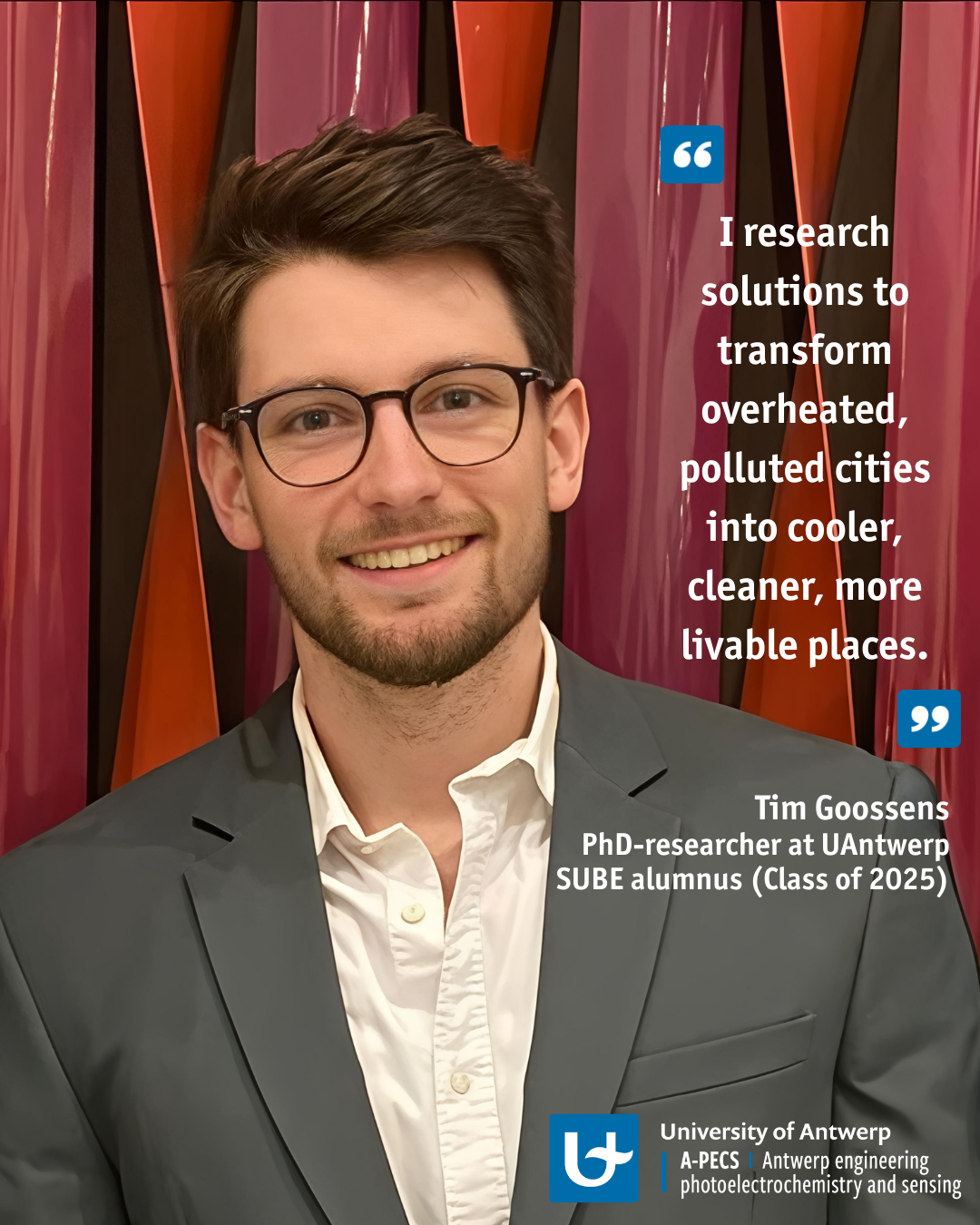
After obtaining a master’s degree, you have two choices: start working and apply what you’ve learned, or continue studying. I chose something in between: a PhD. I never expected to take this path, but the Master of Sustainable Urban Bioscience Engineering (SUBE) — and especially my master’s thesis on the thermal impact of transforming a parking lot into an urban park — completely changed my mind. I really enjoyed working on my own project from scratch. To continue this kind of research, I started a PhD at the research group A-PECS within the Department of Bioscience Engineering at University of Antwerp and now focus on heat stress and air pollution in street canyons.
The CityLabs (and especially the Integrated Cases) included in the SUBE programme were the perfect preparation for my current job. The Conceptual Frameworks still guide me today and give me a solid foundation in urban climate and health. What stayed with me most was the multidisciplinary mindset: not just thinking like an engineer, but understanding the broader urban context. That’s also why my current project is partly embedded in the research group Urban Development and Spatial Planning at the University of Antwerp’s Faculty of Design Sciences.
In my PhD, I now carry full responsibility for my own research project, while also taking on additional tasks such as supervising thesis students and assisting in lectures. It’s safe to say that I remain strongly connected to the Master SUBE.
Before starting my PhD, I went on a trip with two other SUBE alumni, Seppe and Fran. After two years of studying sustainable cities — both through coursework and hands-on projects — we wanted to experience urban sustainability outside the familiar context of the programme. We chose Singapore, often described as one of the most typical examples of a sustainable city. After immersing ourselves in its urban environment, we then escaped into nature of Malaysia and Thailand.
Because the Master SUBE only launched in the academic year 2023-2024 and I finished my bachelor’s degree in 2021-2022, I had to wait a year before starting the master’s programme, but I never regretted this decision and would choose it again in an instant!
Bruna Verhoeven - Tender Engineer at DEME Offshore
- Graduated from the Master SUBE in 2025
- Function: Tender Engineer at DEME Offshore
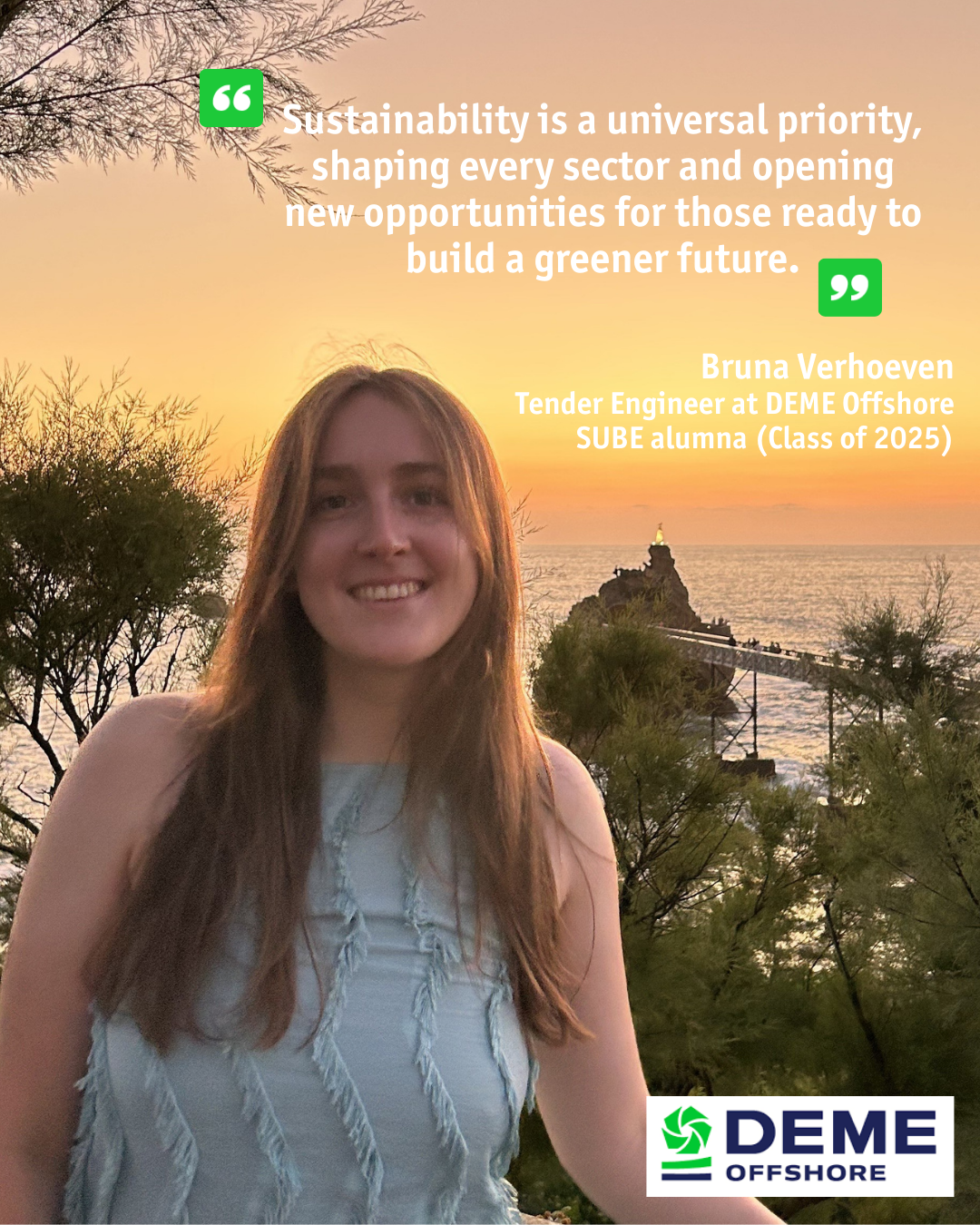
“Sustainability is a universal priority, shaping every sector and opening new opportunities for those ready to build a greener future.” This has always guided me, and it was exactly what drew me to the SUBE programme. Today, I work as a Tender Engineer at DEME Offshore, helping to prepare large-scale offshore projects: from cable installations and wind turbine foundations to landfalls and other offshore wind farm activities. My role combines technical expertise, project planning, and commercial insight, and I take pride in contributing directly to the expansion of renewable energy and innovative offshore technology.
Every day, I work on tender proposals: analysing client documents, defining methods, estimating costs, assessing risks, developing installation schedules, and coordinating with internal teams and external partners. Without a well-prepared tender, a project simply cannot proceed, and being part of that first crucial step is incredibly rewarding.
The SUBE programme prepared me perfectly for this work. As a bioscience engineer, I learned to think in systems: analysing complex ecological, technical, and economic challenges and translating them into actionable plans. My quantitative and modelling skills, combined with strong communication and teamwork abilities, allow me to navigate the multidisciplinary nature of my role. Most importantly, SUBE gave me a sustainability-driven mindset that fits seamlessly with offshore wind projects. While I continue to learn the technical specifics at DEME, SUBE provided me with the professional skills I needed to succeed.
What I enjoy most about my job is that it offers continuous challenge and growth, aligns with my values, and allows me to work on something I genuinely care about. I am supported and encouraged to become the best version of myself, collaborate with inspiring colleagues, and work in a role where no two days are the same. I also get to combine my sustainability expertise with my technical work: I am currently the Sustainability SPOC within the tender department and take part in sustainability-focused workshops, representing DEME in various sustainability-related contexts.
For anyone considering SUBE, my advice is simple: be bold. When I started, some bioscience engineers hesitated because the programme seemed less well known or the career paths unclear. But companies are curious and eager to understand the unique perspective you bring. Sustainability is increasingly important every day, and SUBE prepares you for the future.
Dare to explore. Dare to think outside the box. Dare to choose SUBE.